Thanks to physics, you know that when you increase the temperature of a solid or liquid, its volume will expand. If i understand you correctly, you have a temperature.
Charles Gas Law - Gas Laws Explained
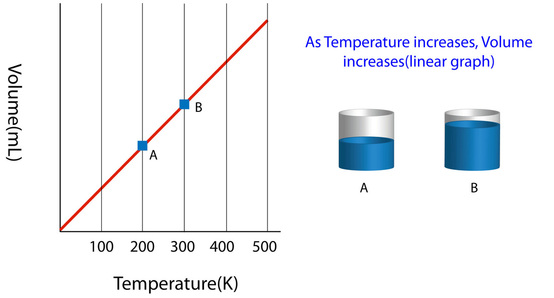
Jun 24, 2014 the volume of the gas increases as the temperature increases.

As temperature increases volume. Recall the relationship that k = o c + 273. In terms of kelvin that's the equivalent of. Also known as the “law of volume,” this law states that volume and temperature are directly proportional to each other.
At low temperatures the particles are concentrated mostly in the lowest available energy levels where as at higher temperatures they’re more spread out. What happens when the temperature of matter increases? Directly proportional is a fancy way of saying that as the temperature increase, the volume of gas increase in a precise way.
As temperature increases, the molecules of the gas have more kinetic. A decrease in temperature caused the water molecules to lose energy and slow down, which results in water molecules that are closer together and a decrease in water volume. We can remove the proportionality sign and.
This shows that the pressure of a gas is inversely proportional to its volume. When an air molecule is hit by an approaching faster moving molecule does the approaching molecule’s rebound speed increase. Volume increases when the temperature increases, because of the molecules crashing into one another therefor they become less pact together.
So, for gases, as the temperature decreases, the volume will decrease also, as long as the pressure remains constant. If a solid or liquid undergoes a small temperature change of just. Charle’s law describes the expansion of gases when they are.
Law states that equal volume of all gases, at the same temperature & pressure, contains equal number ofmolecules variations of pressure & volume atconstant temperature are correlated. For most liquids, as the temperature decreases, the. Temperatures in celsius will not work.
When the volume decreases, the pressure increases. Why does temperature increase when volume decreases? Becomes half medium solution verified by toppr correct option is a) gay lussac's law states that at constant volume, pressure of a fixed amount of a gas varies directly with the temperature.
Increasing the temperature of the air inside would increase the volume according to either of the two equations posted above. So if you halve the volume (v/v' = 2) of a diatomic gas (gamma = 7/5), the temperature will increase by a factor of 2^0.4 = 1.32. Increasing simultaneously both the temperature and pressure of the gas in a container can either produce a change on the volume or the volume can remain constant, depending on the.
With an increase in temperature the particles move faster as they gain kinetic energy resulting in increased collision rates and an. Does temperature decrease when volume increases? A balloon is filled to a volume of 2.20 l at a temperature of 22 o c.
The increase in temperature means an increase in internal energy that, in turn, means that the atoms of your material vibrates more thus displacing more from their. Increasing the volume and since the mass.
Today’s temperature is 30.5 degree celsius, here 30.5 is not a discrete variable and hence is a continuous variable. Temperature is a continuous variable.
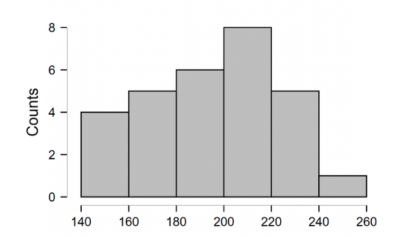
Continuous Data Definition
Temperature can be measured, so it is a continuous variable.
Is temperature discrete or continuous. Studying this data should differ based on which group it falls into. According to measurement accuracy, it can be significantly subdivided into smaller sections. Is age continuous or discrete?
Temperature, weight, height, and length are all common examples of continuous variables. Discrete variables are those variables which value can be whole number only while continuous variables are those whose value can be both whole numbers and fractional number. Over time, some continuous data can change.
It may take any numeric value, within a potential value range of finite or infinite. Temperature is generally considered to be continuous. If you start counting now and never, ever, ever finish (i.e.
Is temperature is continuous or discrete variables? The numbers go on and on until infinity ), you have what’s called a continuous variable. For example, someone could be 22.32698457.
Now let's explore two more data types (discrete and continuous) and help you understand the difference. If discrete data are values placed into separate boxes, you can think of continuous data as values placed along an infinite number line. You may be only able to tell to the nearest tenth of a degree, but that is just due to your.
Temperature is continuous variable as it does have fractional value too. Discrete variables are those variables which value can be whole number only while continuous variables are those whose value can be both whole numbers and fractional number. Age is measured in units that, if precise enough, could be any number.
This is because while the values of a discrete variable is gotten by counting data, the values of a continuous variable are obtained by measuring provided data. But obviously the actual temperature takes on all possible values between 25 and 25.2. Is temperature a discrete or continuous variable?
What is daily temperature, discrete or continuous? This will undoubtedly affect how it's measured as well. The continuous data can be broken down into fractions and decimals, i.e.
Population of a country is discrete variable as it cannot be with fractional values. If your variable is “number of planets around a star,” then you can count all of the numbers out (there can’t be an infinite number of planets). Therefore the set they come from is infinite.
Continuous data is the data that can be of any value. That is a discrete variable. Those are discrete measurements because there's a gap between 25 and 25.2.
“continuous” is a math term relating to functions. Think of the graph of a function. However, at the particle level of physics ,energy is believed to be made of discrete particles, so in actuality temperature may not be.
Is month discrete or continuous? Temperature is a continuous variable because its value assume any value from the set of real numbers between −273 degrees celsius (absolute zero) to positive infinity. It depends on your thermometer.
A temperature is a continuous variable and not a discrete variable. When looking at a set of numbers, they're typically discrete (countable) variables or continuous (measurable) variables.