Amplitude a = 2 period 2π/b = 2π/4 = π/2 phase shift = −0.5 (or 0.5 to the right) vertical shift d = 3 in words: The best videos and questions to learn about amplitude, period and frequency.

Graphing Tangent Functions Period & Phase | How To Graph Tangent Functions - Video & Lesson Transcript | Study.com
On the y axis, we have the traditional number line with positive numbers and negative numbers.

Amplitude period phase shift tangent. Graph of tangent function the formula for this graph is simply y=tan (x). Use the form to find the variables used to find the amplitude, period, phase shift, and vertical shift. For tangent and cotangent, it is pi.
How do you determine the amplitude, period, phase shift and. It explains how to identify the amplitude, period, phase shift, vertical shift, and midline of a sine or cosine function. In addition, it discusses how to graph sinusoidal functions using.
Phase shift of trigonometric functions the general form for the equation of the sine trigonometric function is y = a sin b (x + c) where a is the amplitude, the period is calculated by the constant. Other than that, all the rules are exactly. Determine the amplitude, midline, period, and an equation involving the sine function for the graph shown below.
Identify the normal period of your function. The graph continues on vertically forever the blue graph is the original y = tan x. We call the relevant bit the stretch factor.
Starting at 0°, and moving ¼ of the period (90°), we end up. Arrow_forward determine the amplitude, period, and phase shift of the. Tangent graphs amplitude given an equation y = a tan x, the amplitude of a tan graph is infinite.
The period moves from one point to the next matching point—the peak of the function—the period of a phase shift = 2π/b. You can transform the graph for tangent and cotangent vertically, change the period, shift the graph horizontally, or shift it vertically. Up 2 for 22‐24, write the equation of the following sine.
Period = π b ( this is the normal period of the function divided by b ) phase shift = − c b. Multiple choice questions on determining the amplitude, period, range and phase shift of trigonometric functions with answers at the bottom of the page. Tangents and cotangents don’t have amplitudes.
Y = tan(x +60) amplitude ( see below). Phase shift the phase shift, also known as horizontal shift, refers to. What period does the tangent have?
A) a sine function that has had a phase shift of, 3 a period of 4 , and an amplitude of 5. For sine and cosine it is 2 pi. The 2 tells us it will be 2 times taller than usual, so amplitude = 2 the usual period is.
Right 6 8 vertical shift: Calculating the period algebraically requires a few steps. However, you should take each.
Taking the second derivative is not that challenging because we only need to use the quotient rule. If is both invertible and differentiable, it seems reasonable that the inverse of is also differentiable.
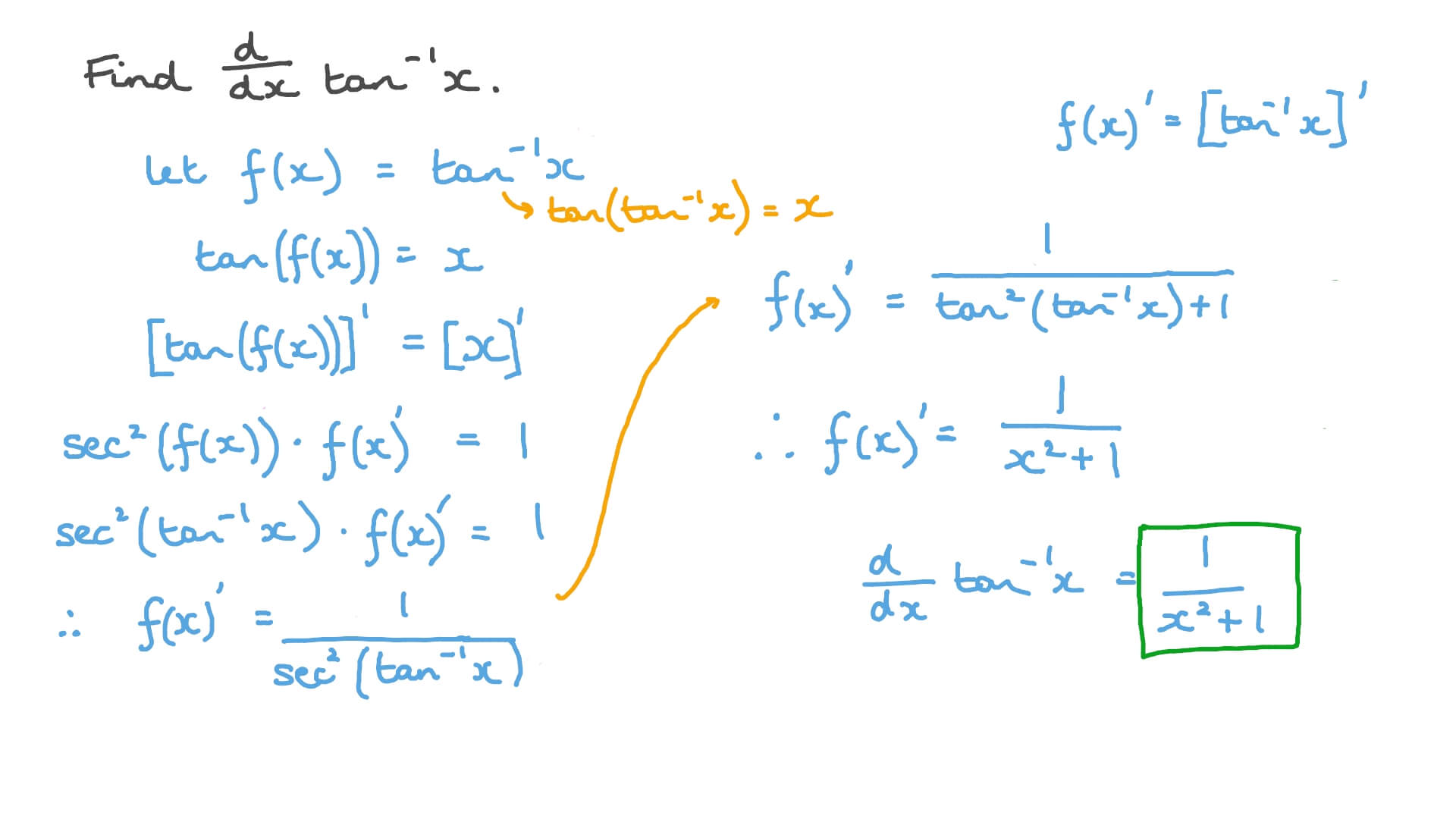
Question Video: The Derivative Of An Inverse Tangent Function | Nagwa
1.) use the simple derivative.
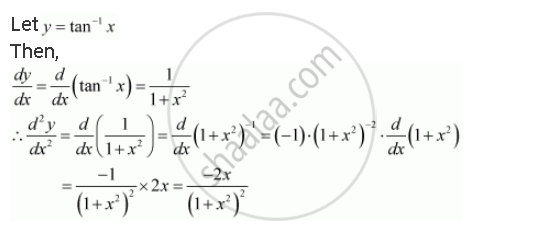
Second derivative of inverse tangent. Sialkot chamber of commerce & industry p.o. What is the second derivative of inverse tangent?. Applying differentiation formulas to an inverse.
Recall that the formula of the quotient rule is: Find the composition f ′ ( f − 1 (. The rest of the inverse trigonometric functions are named in a similar way.
Start by finding its first derivative using the power. The derivatives of the six inverse. We begin by considering a function and its inverse.
Derivative of inverse tangent the following are the formulas for the derivatives of the inverse trigonometric functions we let y=arctan x where limits then tan y=x using implicit. For example when taking the. Therefore, to find the derivative of the inverse tangent function we can start with f (x) = tanx g(x) =tan−1x f ( x) = tan x g ( x) = tan − 1 x we then have, g′(x) = 1 f ′(g(x)) = 1.
🔗 2.6.3 inverse trigonometric functions. H ( x) = x 2 ln ( x) p ( t) = ln ( t) e t + 1 s ( y) = ln ( cos ( y) + 2) z ( x) = tan ( ln ( x)) m ( z) = ln ( ln ( z)) hint. Thanks to all of you who support me on patreon.
To use the derivative of an inverse function formula you first need to find the derivative of f ( x). To differentiate it quickly, we have two options: Use the second derivative test to tell if it is a local maximum or a local minimum.
F ′ ( x) = 2 x. The derivative of an inverse function. The inverse function theorem allows us to compute derivatives of inverse functions without using the limit.
However, it’s better to understand why it’s that. So here i will explain why. A function whose second derivative is positive will be concave up (also referred to as convex), meaning that the tangent line will lie below the graph of the function.
For each function given below, find its derivative. The answer to this question is ##1/ (1+x^2)##. In this case you can use the power rule, so.
You need the second derivative of the function. The inverse of the sine function is known as the arcsine function.