The antiparticle of the electron is called the positron; For germanium, the n = 1, 2, and 3 principal levels are complete (or full) and the.

Inner Core Vs Valence Electrons - Youtube
The structure of an atom

How to find core electrons. A neutral atom has the same number of electrons as protons. The core electrons are those in lower energy shells. Check the news of how to find core electrons.
1s 2 for writing ground state electron configurations, a few main steps should be followed. In this tutorial, you will learn how to find and calculate the number of protons, neutrons, and electrons in an atom or element. We can look at period 2 as an example.
How do you find core and valence electrons? The electrons other than valence electrons are called core electrons. In addition, you will learn about the different subatomic particles.
Calculate effective nuclear charges experienced by valence electrons. Sponsored by best gadget advice Find the amount of electrons in the atom.
Find top topics, trends and opinion of how to find core electrons you need on echemi.com. For all of the preceding elements, the valence electrons are the outermost (highest energy) s and p electrons. But for most of the transition and inner transition elements , the valence electrons are the electrons present in the shells outside the noble gas core.
Evaluate the number of valence electrons and core electrons from the electron configurations.topics: Aluminum is number 13 on the periodic table, meaning a neutral atom of aluminum has 13 protons and 13 electrons. 1s2 2s2 2p3 core elect…
The shielding effect describes the balance between the pull of the protons on valence electrons and the repulsion forces from inner electrons. In this case, we subtract seven valence electrons from a total of 17. Valence electrons reside at the outermost electron shells while core electrons reside at the inner shells.
If you enjoy this tutorial, be sure to check out our others! For example, a nitrogen atom has 5 valence electrons and 2 core electrons according to the electron configuration; How to find core electrons subatomic particle with negative electric charge (−1) for other uses, see electron.
Fill orbitals following the model until all electrons have been accounted for. And the remaining electrons will be the core electrons. Finally, we subtract the number of valence electrons from the total number of electrons to get the number of core electrons.
1s 2 2s 2 2p 3. Being part of group 13, it has. Aboveall, the key difference between valence and core electrons is that valence electrons participate in the.
Continue how to find core electrons in chemistry. 1s 2 2s 2 2p 6.
To find the valence electrons, look at the atom’s main group number. For all of the preceding elements, the valence electrons are the outermost (highest energy) s and p electrons.
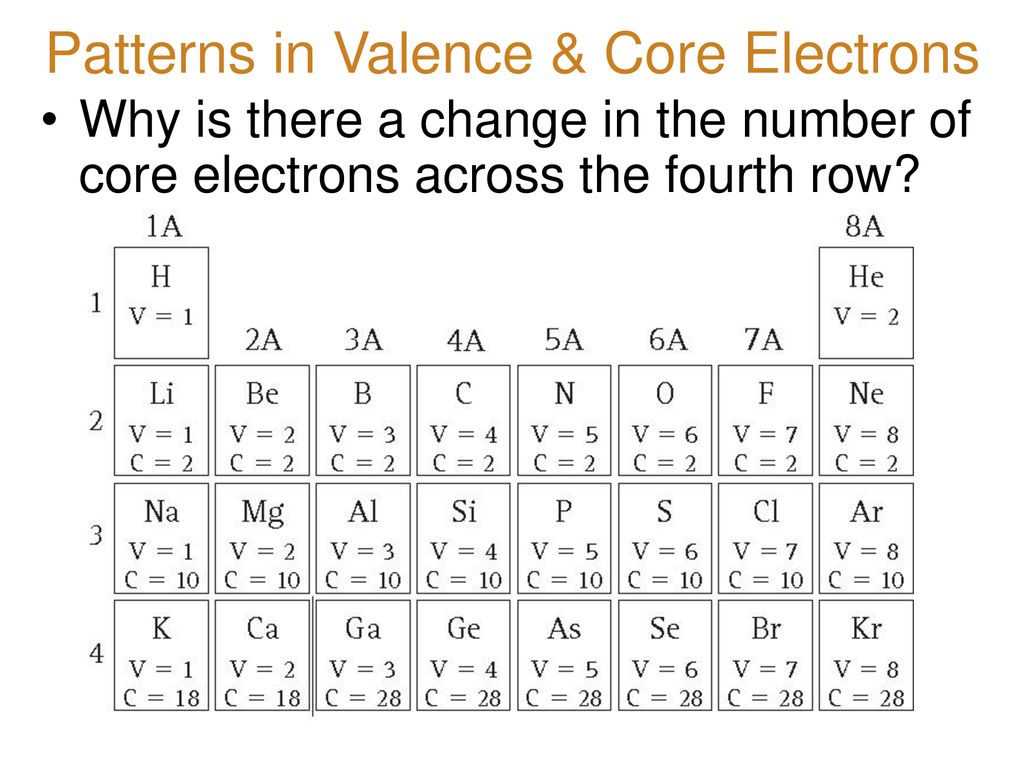
Unit 3: Moving Electrons & Bonding - Ppt Download
That is, there are nineteen electrons in the atom of the potassium element.
How to determine numbe of core electrons. Electrons present in outer most shell (valence shell) are known as valence electrons and rest of the electrons present in inner shells are known as core electrons. How does one determine the number of core electrons an atom has? When we subtract 8 from 15.999, we will get 8.
How do you find core and valence electrons? Some elements have isotopes, which have different masses and therefore different numbers of neutrons. Sponsored by best gadget advice
To determine the valence electrons in an atom, you write the electron configuration of the element. Now the valence shell is n = 2. Aluminum is number 13 on the periodic table, meaning a neutral atom of aluminum has 13 protons and 13 electrons.
This is also equal to the number of. That is, there are fifteen electrons in the atom of the phosphorus element. So, to determine the number of electrons we subtract the valence electrons from atomic number.
Core charge can be calculated by taking the number of protons in the nucleus minus the number of core electrons also called inner shell electrons and is always a positive value in neutral atoms. So, the core shell is n=1 and the number of core electrons =2 The rest of the electrons are the core electrons.
We know that an equal number of protons of atomic number are located in the nucleus of the element and electrons equal to protons are in orbit outside the nucleus. For example, atomic number of n (nitrogen) is 7. Atomic number (z) = number of electrons we know that the atomic number of phosphorus is 15.
The core electrons are those in lower energy shells. So, it is possible to determine the properties of phosphorus from the electron configuration. Where are the core electrons in period 2?
Core electrons are electrons that are present in the inner shells ( other than valence electrons all are core electrons). Its atomic mass is 15.999 atomic mass units (amu) and its atomic number is 8. Sodium ( z = 11 ):
Atomic number (z) = number of electrons we already know that the atomic number of potassium is 19. What is the core of atom called? Electronic configuration of na atom is 1s2 2s2 2p6 3s1 electronic configuration of na+ ion is 1s2 2s2 2p6.
And the remaining electrons will be the core electrons. Core charge is a convenient way of explaining trends in the periodic table. They are located in the outer shell (s) of the electron cloud of an atom.
Being part of group 13, it has. Finding the number of electrons We can look at period 2 as an example.
Subtract the group number from the atomic number. Same as, the boron atom is present in group 3, hence, the number of valence electrons in boron is 3. It has 5 valence electrons.
Examples great, lets apply the rules to some examples. Also, it should be noted that the number of neutrons for an element may vary. A neutral atom has the same number of electrons as protons.
For instance, the oxygen atom belongs to group 6, therefore, the number of valence electrons in oxygen is 6.