Negative ions, by gaining electrons to fill the valence shell b. All atoms strive to have 8 electrons.
How Can We Identify Elements As Metal Or Non-Metals? - Quora
Kq 5 what type of elements ie metals or nonmetals.
What type of charge do nonmetals develop. What charge do group 2a metals form? 1) +2 charge group 2a metals are alkaline earth metals which readily lose 2 electron. Non metals form negatively charged ion.
Hydrogen (sometimes considered an alkali metal) carbon None of the above c. Pages 9 ratings 100% (2) 2 out of 2 people found this document helpful;
Why they are doing is that they need to gain one to three electrons to achieve octet state, making them iso electronic Almost all atoms strive to have 8 protons What is the charge for non metals?
The nonmetals have higher electronegativities than do metals, and compounds formed between metals and nonmetals are generally ionic in nature because of the large differences in electronegativity between them. What charge do group 7a nonmetals form? All atoms strive to have 8 different orbitals.
Group one is composed of metals that have a +1 charge, while all the metals in groups 2,3,4,5,6,7,8,9,10,11,12, and 16 have a charge +2. The metals form cations, the nonmetals form anions, and the resulting compounds are solids under normal conditions. Valance electrons what type of charge do metal ions develop in ionic compounds?
The nonmetals have higher electronegativities than do metals, and compounds formed between metals and nonmetals are generally ionic in nature because of the large differences in electronegativity between them. In normal chemical processes, nonmetals do not form monatomic positive ions (cations) because their ionization energies are too high. By contrast hydrogen, fluorine and iodine only need to gain one electron so they form an anion with a charge of negative one.
What type of elements form anion? The metals form cations, the nonmetals form anions, and the resulting compounds are solids under normal conditions. Positive what does the octet rule say?
When sulphur reacts with oxygen, we get sulphur dioxide. What type of ions do nonmetals form anion negative. These two electrons in the outer shell will be removed to create an ion with a 2 charge to achieve stability and follow the octet rule.
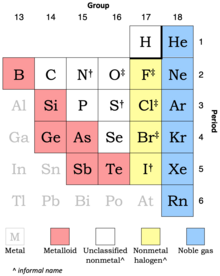
S + o2 → so2 when sulphur dioxide reacts with water it forms sulphurous acid. The nonmetals have higher electronegativities than do metals, and compounds formed between metals and nonmetals are generally ionic in nature because of the large differences in electronegativity between them. List of nonmetals (element group) there are 7 elements that belong to the nonmetals group:
All monatomic nonmetal ions are anions; The metals form cations, the nonmetals form anions, and the resulting compounds are solids under normal conditions. Some common elements that form anions are hydrogen, fluorine, iodine and oxygen.
None of the above a. So2 + h2o → h2so3 5. What type of ions do nonmetals form anion negative circle correct answer 6 are.
Then, metals in groups thirteen and fifteen have a charge of +3. Oxygen needs to gain two electrons so it forms an anion with a charge of negative two. If you look at the periodic table, you will find the metals in groups (from one to 16).
What charge do group 5a nonmetals form? 2 🔴 on a question what type of ions do nonmetals naturally form? Finally, all the metals in group 14 have a +4 charge.
Pe is an organic polymer made of carbon and hydrogen. Compounds containing polyatomic ions are ionic compounds.
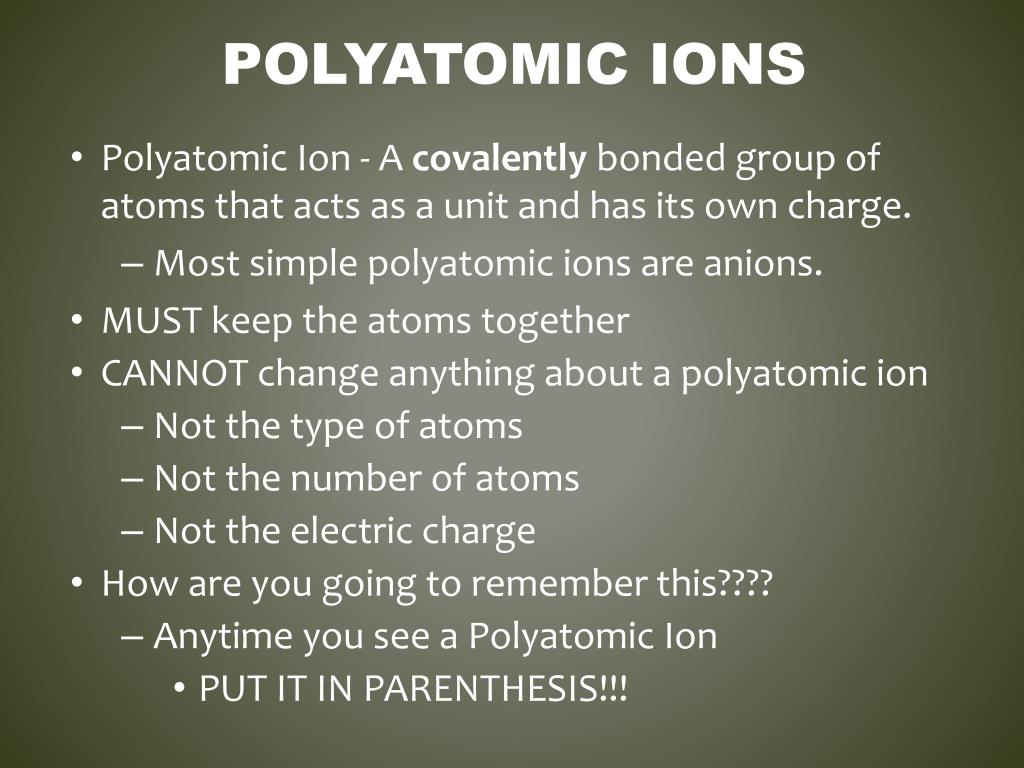
Ppt - Polyatomic Ions & Naming Ionic Compounds Powerpoint Presentation - Id:1996710
Polyatomic atoms combine with different kinds of forces and form the compound.

Are polyatomics metals or nonmetals. Hg, ga ), are brittle (e.g. Next lesson charge and the (main) 8 columns. A polymer is a macromolecular material having a large number of repeating units linked to each other via covalent chemical bonds while metals are either pure elements or.
If you're behind a web filter, please make sure that the domains *.kastatic.org and *.kasandbox.org are unblocked. They are generally poor conductors of heat and electricity. It is composed of all non metal atoms.
They often have 4, 5, 6, or 7 electrons in their outermost shell. In order to be ionic,. Some metals appear coloured ( cu, cs, au ), have low densities (e.g.
Remember, because it is a cation, when it reacts and. • metals usually come in solid forms while nonmetals can be solid, liquid. Polyatomic ions are covalently bonded groups of atoms and having a positive or negative charge caused by the formation of an ionic bond with another ion.
The total number of elements present in the modern periodic table is 118. Copper is found in small amounts in some rocks and soil, but it is much more. While the metals are malleable and ductile, the nonmetals tend to form brittle solids.
The good news, is there are dozens of other polyatomic ions that are relatively easy to figure just by knowing or observing a few patterns. Metals are good reducing agent because it loses electrons easily from their valance shell. Be, al) or very high melting points (e.g.
Generally, polyatomic molecules are also known as compounds. Compounds formed from such a. Polyatomic ions with a positive 1 charge do occur, but the main one you'll encounter and need to know is the ammonium ion.
Many of the nonmetals combine with. No, this molecule is not ionic. • metals are flexible and ductile while nonmetals are not.
Slide 1 naming ionic compounds metals joining with nonmetals or polyatomics slide 2 slide 3 ionic compounds positive ion is called a cation. Properties of nonmetals nonmetals have high ionization energies and electronegativities. The nonmetals tend to gain electrons readily to fill their valence electrons shells, so their.
One is nonmetal and one is metal, and from their polyatomic ions is c12h22o ionic? It stands for “copper.” copper is a metal, but it is not a metal that is found in great abundance. However, the atoms in polyatomic ions are held together by covalent bonds.
W, nb ), are liquids at or near room temperature (e.g. Some of the main physical properties of metals are given below. How many metals and nonmetals are there in elements?
It is covalently bonded so it is not a metal and actually just the opposite, an excellent electrical and thermal insulator.