Can someone walk me through solving this for both a normal cos θ (using arccos θ i assume), and then cos 2 θ? 1 if x is a number then tan − 1 ( x) means the angle between − π 2 and + π 2 whose tangent is x.

Cos^2(1 + Tan^2) = 1 - Youtube
(review inverse cosine here ) decimal.

Cosine squared of tan inverse. The following equation provides the inclination ( i) of a galaxy, using the ratio of its two axes: The angle whose cotangent is 0.577 is 60 degrees. This is true for all angles, not just those on the interval ( − π 2, π 2).
The first one is a reciprocal: You can enter input as either a decimal or as the opposite over the adjacent. Cos 2 i = ( b / a) 2 − ( b / a) e o s 2 1 − ( b / a) e o s 2 all i need however is to determine the value of i.
Inverse tan is the inverse function of the trigonometric function ‘tangent’. Cot (x) = 1/tan (x) , so cotangent is basically the reciprocal of a tangent, or, in other words, the multiplicative inverse. The inverse tan is the inverse of the tan function and it is one of the inverse trigonometric functions.
So the inverse of cot is arccot etc. Opposite is opposite to the angle θ adjacent is adjacent (next to) to the angle θ hypotenuse is the long one Please disable adblock in order to continue browsing our website.
What is cot the inverse of? Sine and cosine are written using functional notation with the abbreviations sin and cos.often if the argument is simple enough, the function value will be written without parentheses, as sin θ rather than as sin(θ).each of sine and cosine is a function of an angle, which is usually expressed in terms of radians or degrees.except where explicitly stated otherwise, this article assumes. Entering the ratio of the adjacent side divided by the hypotenuse.
The cosine of double angle is equal to the quotient of the subtraction of square of tangent from one by the sum of one and square of tan function. Cos 2 θ = 1 − tan 2 θ 1 + tan 2 θ it is called the cosine of double angle identity in terms of tangent function. During calculations involving sine, cosine, or tangent ratios, we can directly refer to the trig chart given in the following section to make the deductions easier.
Cos α =b/h therefore, the inverse cosine formula becomes; When we see “arccot a”, we interpret it as “the angle whose cotangent is a”. The second one involves finding an angle whose sine is θ.
There are 2 different ways that you can enter input into our arc tan calculator. Before getting stuck into the functions, it helps to give a name to each side of a right triangle: Free online inverse cosine calculator works in degrees or radians, plus draws triangle.
It is used to calculate the angle by applying the tangent ratio of the angle, which is the opposite side divided by the adjacent side of the right triangle. Csc θ = 1 sin θ. Sin cos tan chart/table is a chart with the trigonometric values of sine, cosine, and tangent functions for some standard angles 0 o, 30 o, 45 o, 60 o, and 90 o.
Based on this function, the value of. The inverse cosine function is written as cos −1 (x) or arccos (x). \displaystyle \csc \ \theta=\frac 1 { \sin {\ }\theta} csc θ = sin θ1.
It is also known as the arctan function which is pronounced as arc tan.
Taking the second derivative is not that challenging because we only need to use the quotient rule. If is both invertible and differentiable, it seems reasonable that the inverse of is also differentiable.
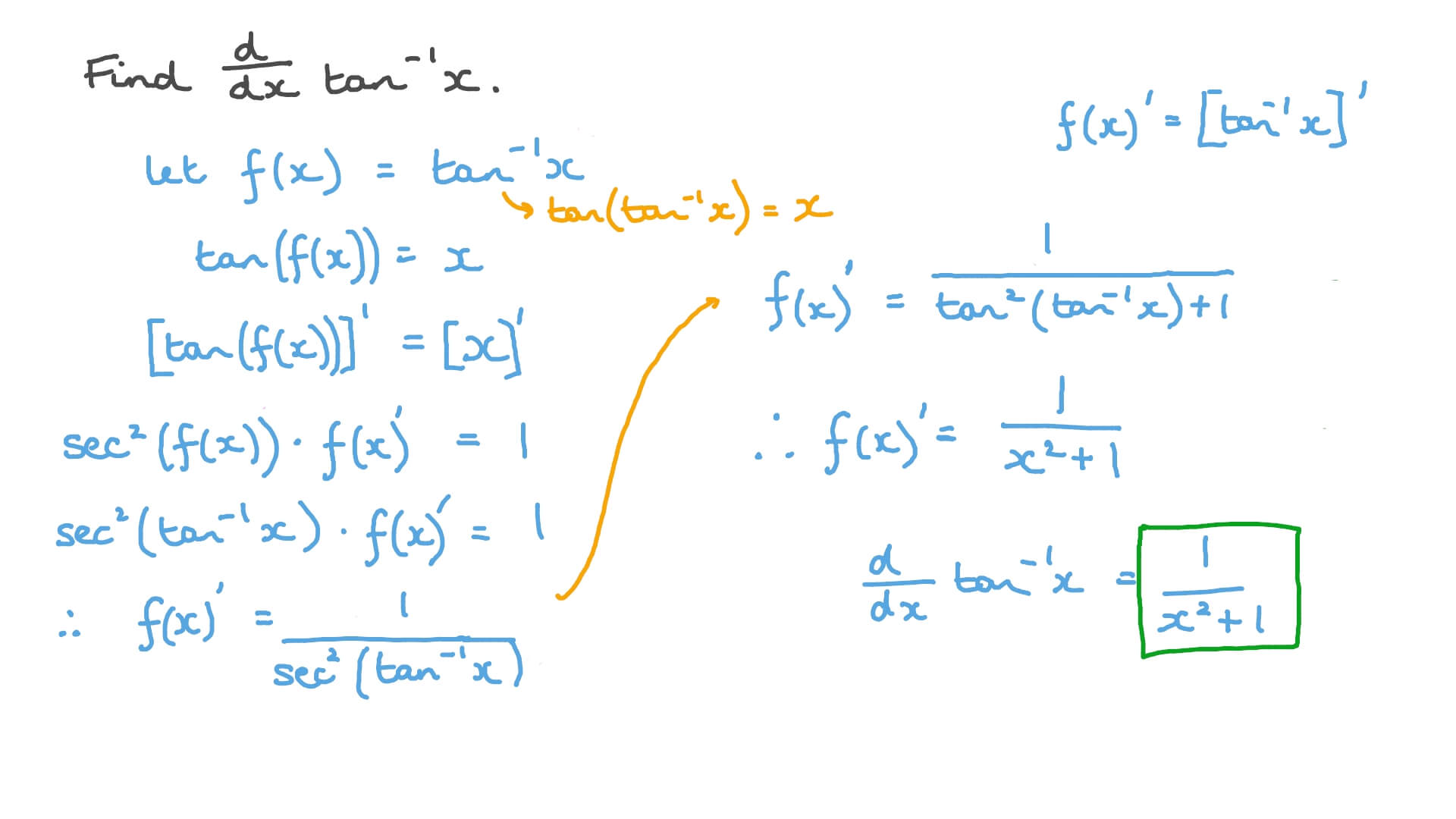
Question Video: The Derivative Of An Inverse Tangent Function | Nagwa
1.) use the simple derivative.
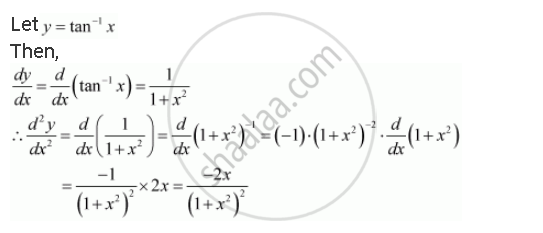
Second derivative of inverse tangent. Sialkot chamber of commerce & industry p.o. What is the second derivative of inverse tangent?. Applying differentiation formulas to an inverse.
Recall that the formula of the quotient rule is: Find the composition f ′ ( f − 1 (. The rest of the inverse trigonometric functions are named in a similar way.
Start by finding its first derivative using the power. The derivatives of the six inverse. We begin by considering a function and its inverse.
Derivative of inverse tangent the following are the formulas for the derivatives of the inverse trigonometric functions we let y=arctan x where limits then tan y=x using implicit. For example when taking the. Therefore, to find the derivative of the inverse tangent function we can start with f (x) = tanx g(x) =tan−1x f ( x) = tan x g ( x) = tan − 1 x we then have, g′(x) = 1 f ′(g(x)) = 1.
🔗 2.6.3 inverse trigonometric functions. H ( x) = x 2 ln ( x) p ( t) = ln ( t) e t + 1 s ( y) = ln ( cos ( y) + 2) z ( x) = tan ( ln ( x)) m ( z) = ln ( ln ( z)) hint. Thanks to all of you who support me on patreon.
To use the derivative of an inverse function formula you first need to find the derivative of f ( x). To differentiate it quickly, we have two options: Use the second derivative test to tell if it is a local maximum or a local minimum.
F ′ ( x) = 2 x. The derivative of an inverse function. The inverse function theorem allows us to compute derivatives of inverse functions without using the limit.
However, it’s better to understand why it’s that. So here i will explain why. A function whose second derivative is positive will be concave up (also referred to as convex), meaning that the tangent line will lie below the graph of the function.
For each function given below, find its derivative. The answer to this question is ##1/ (1+x^2)##. In this case you can use the power rule, so.
You need the second derivative of the function. The inverse of the sine function is known as the arcsine function.
There are six inverse trig functions: Using cartesian coordinates we mark a point on a graph by how far along and how far up it is:.
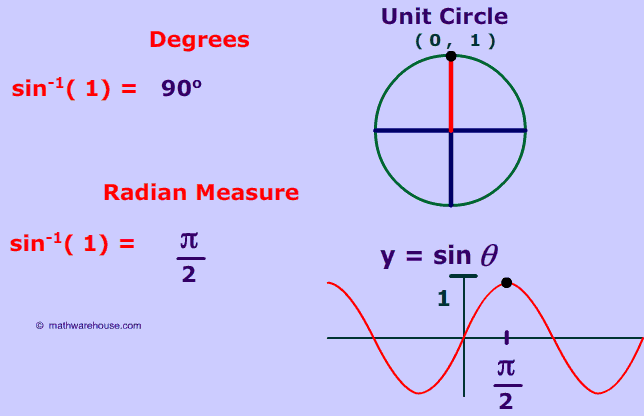
Inverse Sin 1 And -1 : Special Cases Of The Inverse Of Sine Function
They are also termed as arcus functions, antitrigonometric functions, or cyclometric functions.

Sin of inverse tan. More specifically, tan−1(x) = θ is the angle when tan(θ) = x. Is the inverse of tan cot? (review inverse tangent here ) decimal.
Inverses of sin cos and tan inverses of sin, cosine and tangent functions takes the ratio of corresponding functions and gives the angle measure θ. To calculate the value of the tan inverse of infinity (∞), we have to check the trigonometry table. Now, write the values of sine degrees in reverse order to get the values of cosine for the same angles.
Since tan(θ) = opposite adjacent, and here tan(θ) = x 1 we know that As we know, tan is the ratio of sin and cos, such as tan θ = sin θ/cos θ. F ( θ) = sin 2 θ tan θ = sin 3 θ cos θ it comes from a physics setup involving two equivalently massed and charged pith balls separated by a certain distance, and the equation simplifies to q = 4 l sin θ π ϵ 0 m g tan θ, where π, g, and ϵ 0 are the obvious physical constants and l.
Thus, we can get the values of tan ratio for the specific angles. These inverse functions in trigonometry are used to get the angle with any of the trigonometry ratios. Entering the ratio of the opposite side divided by the adjacent.
In this solved examples question no. Prove that 4 ( 2 tan − 1 1 3 + tan − 1 1 7) = π What are the antiderivatives of inverse trig.
Where c is the integration constant. It is helpful to think of tangent as the ratio of sine over cosine, ie: Here, we will define the formula of the tan inverse.
When we include negative values, the x and y axes divide the space up into 4 pieces:. Sin values sin 0° = √ (0/4) = 0 sin 30° = √ (1/4) = ½ sin 45° = √ (2/4) = 1/√2 sin 60° = √3/4 = √3/2 We know this from the definition of inverse functions.
Here you will learn proof of integration of tan inverse x or arctan x and examples based on it. This is also known as tan inverse x. They are the inverses of the six main trig functions.
Inverse trigonometric functions are widely used in engineering, navigation, physics, and geometry. Even though there are many ways to restrict the range of inverse trigonometric functions, there is an agreed upon interval used. You can enter input as either a decimal or as the opposite over the adjacent.
Tanθ = sinθ cosθ = sinθ √1 − sin2θ because x = sinθ we have that tanθ = x √1 −x2 but from sin−1x = θ we get tan(sin−1x) = x √1 −x2 figure answer link I.e., the value of inverse tan of 1 is π/4. There are inverses of the sine, cosine, cosecant, tangent, cotangent, and secant functions.
The point (12,5) is 12 units along, and 5 units up. This video is only available for teachoo black users subscribe now solve all your doubts with teachoo black (new monthly pack available now!) join teachoo. Pleease correct these mistakes and many more.
Sin(tan−1(x)) = x √x2 + 1 explanation: When you add two different tan inverse functions, the formula will be represented as below. Arcsin, arccos, arctan, arccsc, arcsec, and arccot.
Therefore, tan (θ) to equal 1, sin (θ) and cos (θ) must have the same value. It is used to solve problems based on integration and differentiation. Contents 1notation 2basic concepts 2.1principal values
A multiplicative inverse (reciprocal) of a number ‘x’, denoted by ‘1/x’ or ‘x−1’, is a numerical value which when multiplied by ‘x’ yields ‘1’ (the multiplicative identity). First, let's call sin(tan−1(x)) = sin(θ) where the angle θ = tan−1(x). Specifically, they are the inverses of the sine, cosine, tangent, cotangent, secant, and cosecantfunctions,[10]and are used to obtain an angle from any of the angle's trigonometric ratios.
Trigonometric ratio table from the trigonometric ratio table above, we have sin0° = cos90° = 0 sin90° = cos0° = 1 sin30° = cos60° = 1/2 sin60° = cos30° = √3/2 sin45° = cos45° = √2/2 sin0° = tan0° = 0 Rule to find range of inverse trigonometric functions.
First two capital letters form sin, next two form cos and last two form tan. Such that f (g (y))=y and g (f (y))=x.

Differential Coefficient Of `Sec(Tan^(-1)X)` W.r.t `X` Is - Youtube
Similarly, note that cosec is inverse of sin, sec is inverse of cos and cot is inverse of tan.
Tan inverse sec. Rewrite tan(x) tan ( x) in terms of sines and cosines. Write cos(x) cos ( x) as a fraction with denominator 1 1. So to test, lets say i have an angle of 36 and a radius of 286.
Therefore, similarly, trigonometric ratios 1 trigonometric ratios 2 We know that the integration of sec x tan x can be done as the reverse process of the differentiation of sec x. Don’t worry it will be clear with the following.
Geometry right triangles and trig sine, cosine and tangent functions ← prev question next question → free jee main mock test free neet mock test class 12 chapterwise mcq test Concept notes & videos 974.
Try byju‘s free classes today! Cbse cbse (science) class 12. Give the bnat exam to get a 100% scholarship for byjus courses.
Now, we will prove that the integral of sec x tan x is equal to sec x + c by writing sec x and tan x in terms of sin x and cos x. And my next question is that how to use the sec function? Entering the ratio of the opposite side divided by the adjacent.
Cancel the common factor of cos(x) cos ( x). This video is only available for teachoo black users subscribe now solve all your doubts with teachoo black. Then we get sec 2 y (dy/dx) = 1 dy/dx = 1/sec 2 y.
It is used to find the angles with any trigonometric ratio. You can enter input as either a decimal or as the opposite over the adjacent. = 1−tan 2x1+tan 2x = 1+1.tan 2x1−tan 2x = 1+tan 4π.tan 2xtan 4π−tan 2x =tan(4π− 2x) (∵tan(a−b)= 1+tanatanbtana−tanb) secx+tanx=tan(4π− 2x) tan −1(secx+tanx)= 4π− 2x ∫tan.
So the answer for the tangent (utangent) must be 92.927. So i used the math.h library in order to use the sin, tan, cos, and sec function but the answers are not right based on my formula. Rule to find range of inverse trigonometric functions.
Here you will learn differentiation of sec inverse x or arcsecx x by using chain rule. Here you will learn proof of integration of tan inverse x or arctan x and examples based on it. (review inverse tangent here ) decimal.
Rewrite sec(x) sec ( x) in terms of sines and cosines. Multiply by the reciprocal of the fraction to divide by 1 cos(x) 1 cos ( x). To determine the sides of a triangle when the remaining side lengths are known.
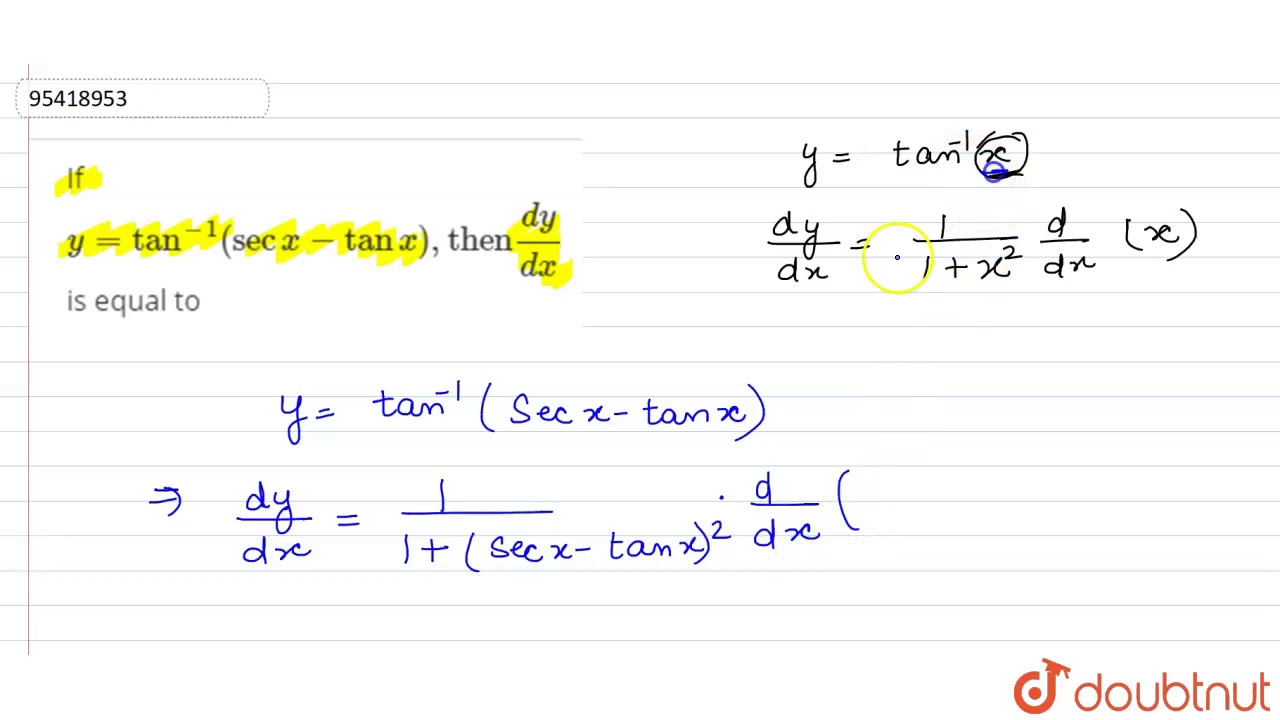
The inverse trigonometric functions are the inverse functions of basic trigonometric functions, i.e., sine, cosine, tangent, cosecant, secant, and cotangent. D/dx tan^ 1 ( sec x + tan x) = question. Find the secant of the inverse tangent of 1/2
We will use the different formulas of trigonometry and the substitution method of integration. Even though there are many ways to restrict the range of inverse trigonometric functions, there is an agreed upon interval used. We differentiate this on both sides with respect to x using the chain rule.
Differential coefficient of sec sec ( tan − 1 x ) is. Where c is the integration constant. Example of inverse trigonometric functions:
Try byju‘s free classes today! Sec square (tan inverse 2) +cosec square (tan. Sec square (tan inverse 2) +cosec square (tan inverse 3) = afreen , 5 years ago grade:12th pass 1 answers aryan prajapati 21 points 5 years.
Integration of tan inverse (secx + tanx) dx 2 see answers hi (secx × tanx ) tanx + ( sec²x × secx) answer 3.4 /5 22 kvvijin77 ∫tan⁻1 (secx+tanx) =∫∫tan⁻1 (1/cosx+sinx/cosx) hi.