When it’s forming a bond to hydrogen (in an elimination reaction, for instance), we say it’s acting as a base. Is naoh an acid base.

Which Is A Stronger Base Naoh Or Baoh? - Brainly.in
(actually hydroxide is the only exsistable strong base ion in water.
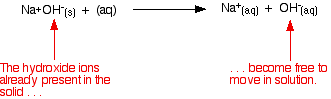
Naoh strong base. A it gives oh − ion b it can be oxidised c it ionises completely d both a and c medium solution verified by toppr correct option is d) naoh is a strong base because it ionises completely in aqueous solution and it gives oh − and na + ions in aqueous solutions. Leave a comment / chemistry / by admin. Because strong bases fully dissociate in water, they produce lots of hydroxide ions in solution, making the solution more basic.
And the amount of oh — ions in an aqueous solution is very high and we know oh — ions have a tendency to accept the proton. Sodium hydroxide (naoh) is strong base because it fully dissociates in water to produce hydroxide ions. Naoh is a strong base because:
While weak bases produce fewer hydroxide ions, making the solution less basic. Naoh is a strong base. Hence, option d is correct.
A strong base is one that completely dissociates (breaks apart) in solution. Yes, nah is a stronger base than naoh. We can easily find the strength and concentration of hydroxide ions by measuring the ph of the solution.
Take a species like naoh. $\begingroup$ the aqueous chemistry of the elements by george k. While ammonia (nh 3) is weak base because it accepts protons from water to produce fewer hydroxide ions in solution.
Naoh is a strong base. Arrhenius acid act as a good electrolyte as it dissociates to its respective ions in the aqueous solutions. 0.5 (1) (1) (0) choose an option that best describes your problem.
Naoh is a strong base that is used in the production processes for numerous products, such as paper, textiles, rayon fabrics, soap, cleaning metals, and detergents. It is corrosive and is very dangerous. For a base, we need to know the concentration of hydroxide ions, so we have poh.
What will be the ph of 5.0×10 −2m naoh solution? Make sure you wear a mask when working with it. Naoh is a strong base, and therefore its ph is more than 7 and nearer to 14.
(log 2=0.3) a 14.00 b 13.70 c 13.00 d 12.70 hard solution verified by toppr correct option is d) given that, 5.0×10 −2m naoh≡[oh −]=5×10 −2m [h +][oh −]=1×10 −14 Strong bases are characterized by the fact that they dissociate completely in aqueous solution. Nah is better at deprotonation when compared to naoh.
(log 2 = 0.3) question naoh is a strong base. Is naoh a strong base or nucleophile? Here is a list of the most common strong bases.
Naoh is a stronger base than koh. You thus have naoh(aq) → na+ (aq) +oh− (aq) Is naoh an acid or base?
Sodium hydroxide (naoh) is strong base because it fully dissociates in water to produce hydroxide ions. Best answer 1 so, is naoh a strong base? These are classic arrhenius bases.
Because strong bases fully dissociate in water, they produce lots of hydroxide ions in solution, making the solution more basic. It is important to be careful when handling it. No moles of it remain undissociated inside the solution.
Naoh is a strong base, so this will produce 0.1mol/l of oh ions in solution. Koh is more soluble in water than naoh. In this case, sodium hydroxide, naoh, is classified as a strong base because it dissociates completely in aqueous solution to form sodium cations, na+, and hydroxide anions, oh−.
A conjugate base is an acid that has lost a proton: Some of strong bases are naoh, koh, ba (oh) 2. Keeping it similar to the general acid properties, arrhenius acid also neutralizes bases and turns litmus paper into red.
This will produce a ph of 13. It’s both a strong base and a good nucleophile.
Citric acid+ n aoh→ sodium citrate+ h2o citric acid + n a o h → sodium citrate + h 2 o balanced chemical. Assuming alkali solution was added to 25 cubic centimeters (cc or ml) of juice.

Spectra Of The Treatments With Citric Acid And Naoh:urea Solution In... | Download Scientific Diagram
10 rows citric acid and sodium hydroxide are used for all three presented titrations.

Citric acid and naoh. Balance the equation for citric acid reacting with sodium hydroxide. When it is combined with citric acid, the water in the aqueous acid solution will cause the baking soda to dissolve, generating sodium ions and hydrogen carbonate ions in solution. The molecular weight of citric acid (without water) is 192.123 grams the molecular weight of citric acid monohydrate is 210.038 g.
The amount of naoh used is equal to three times the amount of citric acid reacted. Citrate buffer (10mm citric acid, 0.05% tween 20, ph 6.0): Read the initial volume of naoh solution in your buret to the nearest hundredth of a ml.
The hydrogen ions can combine with hydroxide ions to produce. And here's what you got (obviously, turn in your own data): 0.00805moles naoh ⋅ 1 mole citric acid 3moles naoh = 0.00268 moles citric acid now simply divide the mass of citric acid given by the number of moles it contained to get the.
1 citric acid, being an acid can contribute a hydrogen ion and naoh consists of a hydroxide ion. Adjust ph to 6.0 with 1n naoh and then add 0.5 ml of. The reaction 3 naoh (aq) + h 3 c 6.
Slowly add the naoh solution to the soft drink until the first faint lasting pink color appears. X = 0,043 g cictric acid / g lemonade powder if my first question is wrong, and there is a recipe to prepare the juice, replace 100g with the mass to prepare 100ml of juice Conversion of standard (0.3125 n) alkali solution (naoh) to percent anhydrous citric acid (% acids).
The reaction of sodium hydroxide with citric acid is: Based on your results in the previous calculation, determine the concentration of citric acid for each trial. Group i metal hydroxides (lioh, naoh, etc.) group ii metal hydroxides (mg(oh)2, ba(oh)2, etc.) strong bases completely dissociate in aq solution (kb > 1, pkb < 1).
I would suggest that you dissolve citric acid (pure acid, not a sodium salt) in water and then adjust the ph with 5m sodium hydroxide until you have the ph you need, 2.5 or 3. Refer to part 1 for the background information and the titration method. Standardise naoh using 1 (n) succinic acid.
Starting with 30 ml of 0.1 m citric acid, calculate the initial ph and the ph at each 5 ml increment of 0.1 m naoh until you are 10 ml past the last equivalence point. Therefore, 1 mol of citric acid neutralizes 3 mol of naoh. A diluted sample is tritiated with 0.02 n naoh to find the free citric acid content.
Concentration of hydroxide ion [oh¯] = 3.0x10¯³ m poh =? Naoh güçlü bir baz olduğu için tamamen su içinde iyonize olur.
W Arm -U P What Is The Ph Of A M Solution Of Hi? What Is The Poh Of A M Solution Of Naoh? What Is The [H+] Concentration Of A Solution
Then the ph of hcl solution having same.
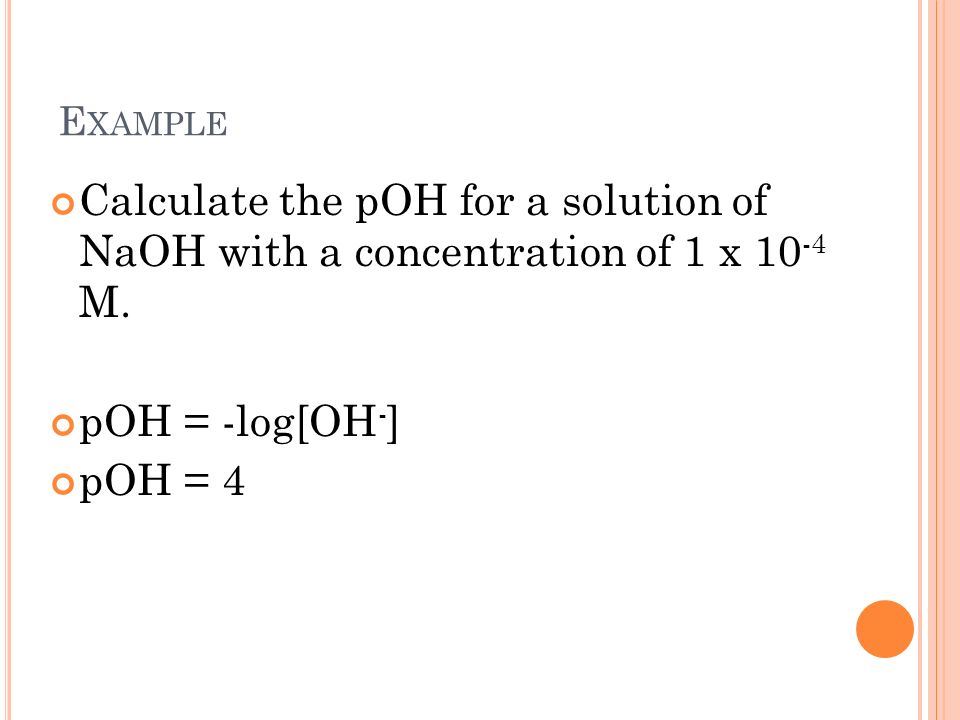
Poh of naoh. Molar concentration is equal to moles of solute per liter of solution: Solution verified by toppr correct option is d) the hydroxide ion concentration in neutral water is 10 −7. This will produce a ph of 13.
The hydroxide ion concentration in 10 −8 m naoh solution will be 10 −7+10 −8= 10 −7×1.1 poh=−log[h +]=−log10 −7×1.1=7−log1.1=6.96. Now you apply poh+ph =14 (at 25 degree centigrade) to calculate ph of 0.5 m naoh. 100% (1 rating) transcribed image text:
Now you apply poh+ph =14 (at 25 degree centigrade) to calculate ph of 0.5 m naoh. Of naoh is 0.5 , from this you can calculate poh. 0 0 similar questions the ph value of ordinary water is:
Calculate the ph and the poh of each of the following solutions at 25∘c for which the substances ionize completely: You are given that the ph = 4.5. 1 chemical foundations 2 atoms, molecules, and ions 3 stoichiometry 4 types of chemical reactions and solution stoichiometry 5 gases 6 thermochemistry 7 atomic structure and periodicity 8.
Since ph + poh = 14 we can calculate the ph to be 13. 1 mole of naoh produced 1 mole of oh¯. 4 answers #2 for a were told about the h three.
This can be obtained as illustrated below: Oh plus similarity is equal to 5.3 times 10 to the negative. You will need to take the negative log of 0.1 to find the poh.
Therefore, 3.0x10¯³ m naoh will also produce 3.0x10¯³ m oh¯. H two before we can calculate the ph by subtracting the p. You will need to know the molarity of the naoh.
Arrhenius acid act as a good electrolyte as it dissociates to its respective ions in. Sonra, ph + poh = 14 formülünü uygulayın. The relationship between the ph and the p.
There are a few different formulas you can use to calculate poh, the hydroxide ion concentration, or the ph (if you know poh): To calculate the molar concentration of , we can use the known values for the moles of and the volume of solution: Egzersiz yapın [0.1] = 1.
Let's assume the solution is 0.1m. Ph plus ph equals 14. Chemical equilibrium and ionic equilibrium are two major concepts in chemistry.
Of naoh is 0.5 , from this you can calculate poh. Naoh is a strong base, so this will produce 0.1mol/l of oh ions in solution. Poh value of 2×10 −4 m naoh solution is :
Ionic equilibrium deals with the equilibrium involved in an ionization process while chemical equilibrium deals with the equilibrium during a chemical change. (a) 0.000259mhclo4 (b) 0.21 m naoh (c) 0.000071m ba (oh) 2 (d) 2.5m koh. H is found through the number of 14.
So if we know the p o. This will work out to be 1. The poh of naoh is 2.
Three moeller before our ph will be negative. Of naoh is 0.5 , from this you can calculate poh. The concentration of in the solution is.
The poh of a 0.260 m solution of naoh is. A 3.7 b 2.7 c 4.3 d 3.3 medium solution verified by toppr correct option is a) poh =log (2×10 −4) =[log 2+log 10 −4] =−log 2+4 =4−0.3010. Finally, we shall determine the poh of the solution.
Calculate the molar concentration of. That will give you the log of the concentration and then changing the sign by hitting the plus or minus sign and you'll get 4.0. Now you apply poh+ph =14 (at 25 degree centigrade) to calculate ph of 0.5 m naoh.